If you’ve sourced CNC parts for more than a year, you’ve seen this pattern:
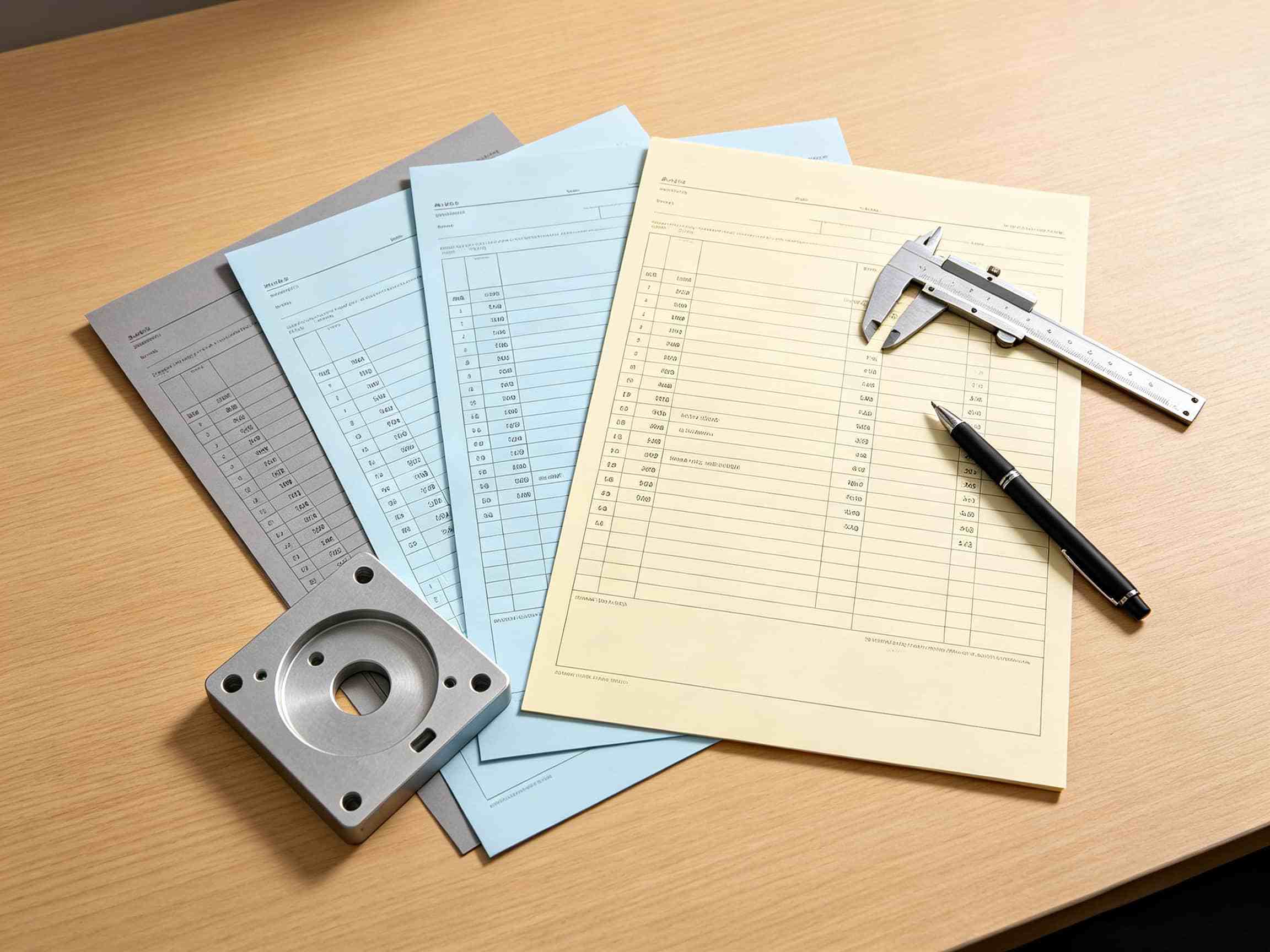
You get three quotes. One is visibly cheaper. You go with it. Then two weeks later, you get hit with setup fees, deburring charges, inspection costs, and expedite fees. By the time parts land at your door, you’ve paid more than the “expensive” quote.
I’ve been on both sides of this table — as a supplier and as a buyer. After 12 years and hundreds of RFQs from clients in Germany, the UK, France, and the US, I can tell you: the unit price alone tells you almost nothing.
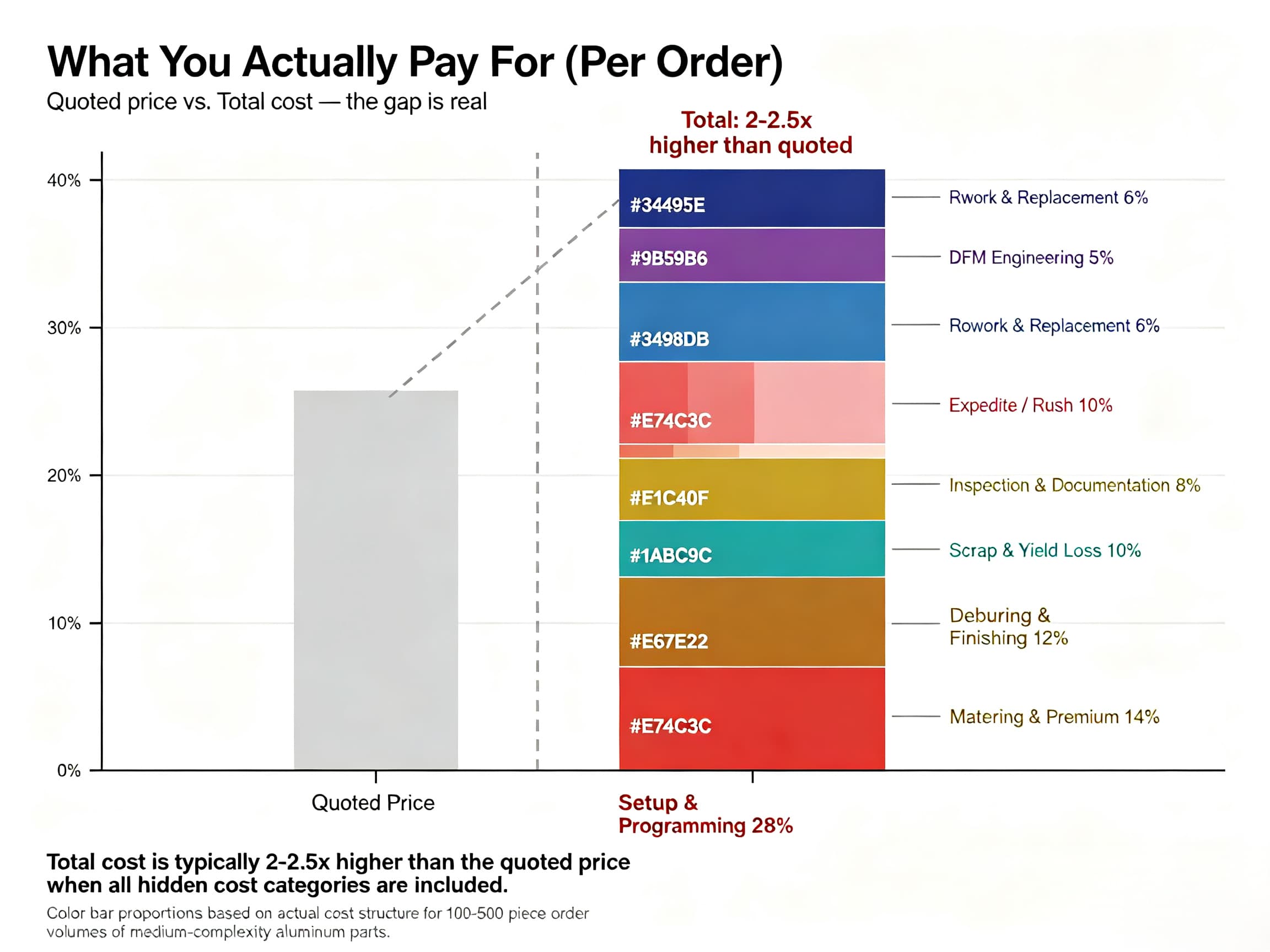
What follows is a breakdown of the nine most common hidden costs in CNC quotes, and how they compare between typical Western local shops and Chinese suppliers like us. The goal isn’t to say “China is always cheaper.” It’s to show where the real differences are — and where they aren’t.
Key Note on Pricing
The figures in this article are based on actual cost structures we’ve observed across multiple projects — but every part is different. A simple aluminum bracket will have very different cost drivers than a complex 5-axis medical component. Use the comparisons here as a framework to evaluate quotes for your specific project, not as fixed price benchmarks.
Typical Western approach: These are almost always separate line items. Setup typically runs $150–$500 per operation, and programming for 4/5-axis work adds another $100–$300. For low-volume orders, setup alone can be 30–50% of the total.
Typical Chinese approach (including ours): Setup and programming are absorbed into the unit price for orders over about 20 pieces. For prototypes or smaller runs, there’s a one-time fee — but it’s usually about 30–40% of what a US/EU shop would charge.
When the gap is real: For orders of 20–200 pieces, this is significant. For 1–5 pieces, the setup cost is real no matter where you go — but even then, the labor-rate difference keeps the fee smaller.
When the gap shrinks: Highly complex 5-axis work with long programming time. Here, the engineering effort dominates, and the location difference matters less.
Typical Western approach: Deburring is manual labor, billed by the hour — typically $80–$150/hour. For parts with undercuts or complex geometry, it can add 20–30% to the total.
Typical Chinese approach: We design the process to minimize burrs from the start. 4/5-axis machining with sharp tools and appropriate toolpaths leaves far less burr. What remains is included in the unit price — not a separate line item.
Caveat: A 3-axis quote that doesn’t mention deburring is often a red flag. Ask. If it’s not included, it’s coming later.
|
Service |
Typical Western Approach |
Typical Chinese Approach (Ours) |
|
Material certs |
Often extra |
Included |
|
CMM full inspection |
$100–$300 per order |
Included for production orders |
|
PPAP / full FAI |
Billed as engineering time |
Included for automotive/medical orders |
|
Third-party lab testing |
Always extra |
Extra — we don’t absorb lab fees |
Key factor: The cost gap here depends entirely on the level of documentation you need. For basic production parts, the difference is moderate. For medical/aerospace/automotive work, it can be substantial.
Typical Western approach: Material markup is common — 20–50% above mill price. For exotic alloys like titanium or Inconel, the premium is often higher.
Typical Chinese approach: Direct sourcing from local mills. For common materials like 6061 aluminum and 304 stainless, the base material cost is typically 30–40% lower. Volume orders multiply this advantage.
Limitation: For exotic materials that aren’t commonly produced in China (certain specialty alloys), the gap shrinks or reverses. Always check the material origin.
|
Factor |
Typical Western Approach |
Typical Chinese Approach (Ours) |
|
Standard lead time |
4–6 weeks |
7–15 days (most orders) |
|
Expedite fee |
50–100% of order value |
15–25% for 3–5 day turnaround |
|
Capacity for rush |
Often limited — backlogged |
20% spare capacity held for urgent work |
The practical difference: If you need parts in 2 weeks, a Western shop may charge a heavy premium because they’re pushing other work aside. We build rush capacity into our schedule deliberately.
Typical Western approach: If parts are out of spec, it’s a conversation about fault. If it’s the shop’s error, they redo them — but you wait another 4–6 weeks. If it’s a customer-side design change, you pay full price again.
Typical Chinese approach: If we make a mistake, we remake them for free and air-freight at our cost. If you make a design change, we charge the incremental machining cost — not a full new setup fee.
The real cost: The hidden cost here isn’t the rework itself. It’s the downtime. A 4-week rework delay in Europe can shut down an assembly line. That’s where the difference matters most.
Typical Western approach: Local trucking is straightforward. But export crating and international shipping add up quickly — especially for large or heavy parts.
Typical Chinese approach: Export packing is done in-house. DHL/FedEx door-to-door air freight from China to Europe runs about $150–$300 for a typical 50kg order, 3–5 days transit.
On sea freight: For larger orders, the per-unit shipping cost becomes negligible. We’ve seen clients assume shipping will wipe out their savings — and for most orders under 500 pieces, it simply doesn’t.
Typical Western approach: DFM review is engineering time — $120–$200/hour. Many shops will just machine what you send them, even if the design is costly to produce.
Typical Chinese approach: Free DFM review is standard. We’ll flag sharp internal corners that add tooling cost, unrealistic tolerances, or simple design changes that could cut your price by 30%.
Note: This is the most underrated value of sourcing from a capable Chinese shop. A good DFM review saves more money than the hourly rate difference.
Typical Western approach: Not line-itemed, but baked into the price. If a shop runs 8% scrap, you’re paying for 108 parts for every 100 you receive.
Typical Chinese approach: With 4/5-axis machining and in-process probing, stable production scrap rates under 1% are achievable.
When the gap is real: High-volume production. Scrap gets multiplied across thousands of parts, and the difference adds up.

· Is setup included in the unit price?
· Is deburring included?
· Are inspection reports included?
· What’s the standard lead time — and what does expedite actually cost?
·· What happens if parts are out of spec — and who pays for rework?
Cheap unit prices can be very expensive. The right question isn’t “how much per piece?” It’s “what’s included, and what happens if something goes wrong?”
If you’re comparing quotes from different suppliers and you’re not sure what’s actually included, send them both to us. We’ll decode them and tell you which one is the real deal.
Want a transparent, all-in quote for your next project? Send your CAD files and quantity. You’ll get one flat price — everything included, no line items, no hidden fees.
tel : 0755-23596843
WhatsApp : +86-13267211181
E-mail : sales02@gt-proto.com
No.18, Shaqi Community Center Road, Xinqiao Street, Baoan District, Shenzhen, Guangdong Province, China 518104
Links :
test© 2026 Shenzhen GT Prototype Co., Ltd Tutti i diritti riservati.
Mappa del sitopolitica sulla riservatezzaXml